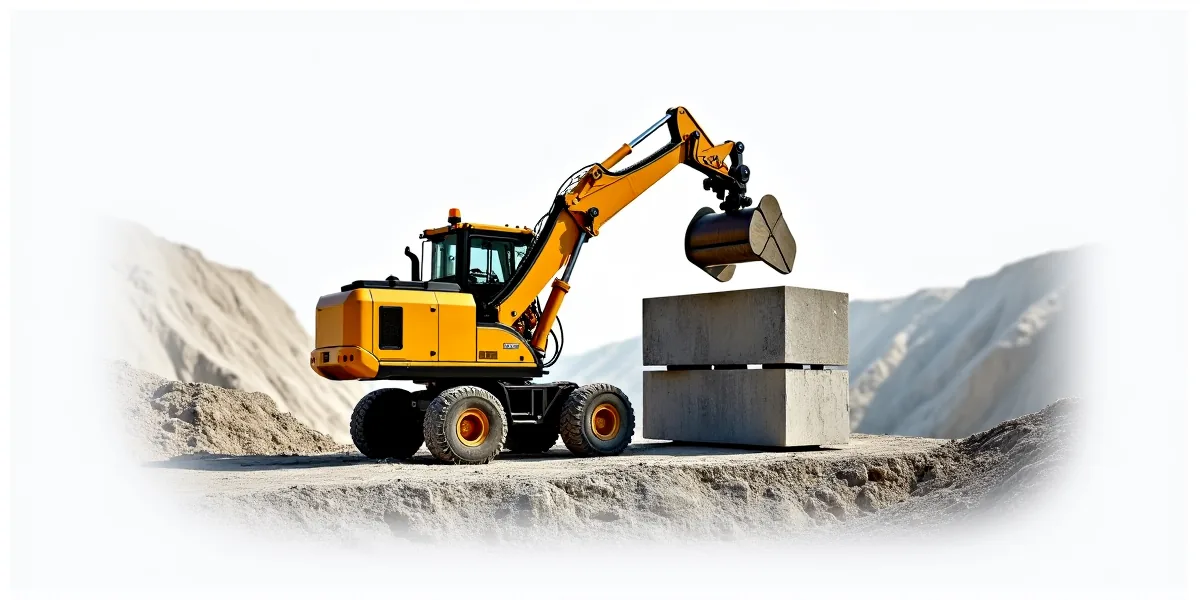
What Exactly Is a Block Handler and Who Needs One?
If your operation involves moving dense, heavy monolithic loads like raw stone or large precast concrete elements, a standard forklift is likely the wrong tool for the job. A Block handler is a specialized machine designed specifically for this purpose. It looks somewhat like a wheel loader, but it is built with a reinforced frame, heavy counterweights, and thick forged forks to handle loads that would tip over or crush a regular forklift. These machines are the backbone of granite and marble quarries, precast concrete plants, and stone fabrication yards. They are engineered to operate on rough, uneven outdoor surfaces where standard warehouse forklifts simply cannot go. If you are regularly lifting solid blocks weighing 10 tonnes or more on gravel or rock, you need a block handler.
Understanding Capacity: Rated Load vs. Tipping Load
The most critical mistake buyers and operators make is confusing rated capacity with tipping load. These are two different numbers, and understanding the difference is vital for safety and productivity. The rated capacity is the maximum weight the manufacturer certifies for safe, regular use. This number assumes ideal conditions: level, hard ground, a standard load center, and the forks fully under the load. For a mid-size machine, this might be 20 tonnes.
The tipping load is the absolute physical limit before the machine overturns forward. This is typically 1.6 to 2.0 times the rated capacity. On a 20-tonne rated handler, the tipping load might be 32 to 40 tonnes. You should never operate near this limit. Manufacturers build in a safety margin of about 50-60% between the two figures to account for real-world variables like uneven ground, sudden stops, or slight load offsets. If you treat the tipping load as your working capacity, you are inviting a catastrophic accident. Always check the specific load chart for your machine, as capacity drops significantly as the lift height increases or if the Block’s center of gravity shifts forward on the forks.
Sizing Your Machine to the Job
Block handlers come in a wide range of sizes, and choosing the wrong one can lead to either safety risks or unnecessary operating costs. Small models, rated between 8 and 12 tonnes, are suitable for precast yards and small stone workshops handling wall panels or palletized masonry. They are easier to transport and have a smaller footprint. The most common workhorse is the mid-size handler, rated from 16 to 23 tonnes. These machines are ideal for standard quarry operations, handling 15-20 tonne granite or marble blocks and loading them onto trucks. They offer a good balance of power, lift height, and maneuverability.
For larger operations, heavy handlers rated at 28 to 32 tonnes are used for massive raw stone Blocks in medium to large quarries. At the top end, ultra-heavy units rated 40 to 52 tonnes are built for dockside handling and large-scale quarry extraction. These massive machines require wide access roads and often need special oversize permits to move. A practical rule of thumb is to match the machine’s rated capacity to your heaviest frequent load, but ensure you have enough margin to account for lift height. If you are lifting blocks to the top of a truck bed, your usable capacity will be significantly lower than the number on the nameplate.
Why a Block Handler Beats a Standard Forklift
You might wonder why not just buy a larger rough-terrain forklift. The answer lies in stability and durability. Standard forklifts are designed for pallets on flat, paved surfaces. When you put a dense, concentrated stone Block on a forklift and drive it over loose quarry gravel, the center of gravity shifts unpredictably, leading to a high risk of tipping. Block handlers have a much lower center of gravity relative to the load and massive rear counterweights engineered specifically for forward-heavy loads.
Furthermore, the components are built differently. Block handler forks are thick forged steel designed to absorb the shock of heavy stone impact, whereas standard forks can bend or crack under repeated heavy loads. The cooling systems on block handlers are also more robust, often featuring reversible fans to clear out rock dust, which is a constant problem in quarry environments. A standard forklift will overheat quickly in these conditions. Finally, block handlers have higher ground clearance and articulated steering, allowing them to navigate mud, loose rock, and uneven terrain without getting stuck or bottoming out.
Practical Advice for Safe Operation
Even the best machine is only as safe as the operator and the site conditions. First, always inspect the forks daily. Cracked, bent, or worn forks are a major hazard and can fail under heavy stone loads. Second, pay close attention to the ground. Soft gravel, mud, or slopes drastically reduce stability. Never lift a maximum rated load on a slope, even a slight one. The side slope creates a tipping moment that the machine is not designed to handle.
Load centering is equally important. Keep blocks tight against the fork backrest to maintain the correct load center. An off-center load creates a larger moment and reduces safe capacity immediately. If you are working in a quarry or precast yard, use a spotter when working near edges, drop-offs, or truck beds. Many fatal accidents occur when operators fail to account for an incorrect load center or attempt to lift a block that is too heavy for the current lift height. Use portable scales if necessary to verify block weights before lifting. The goal is to maintain that safety margin between rated capacity and tipping load at all times.
Conclusion
Selecting the right block handler is about matching the machine’s specific stability and capacity profile to your material and site conditions. Whether you are in a precast concrete plant or a granite quarry, the machine must be sized appropriately to handle your heaviest loads with a safe margin for error. Do not rely on the tipping load as a working figure, and always respect the limitations of the terrain. By choosing the correct size class and adhering to strict load center and ground condition protocols, you can maximize productivity while keeping your team safe. For most general stone and precast operations, a mid-size handler offers the best balance of capability and versatility, but your specific daily tonnage and lift heights should be the final deciding factor.