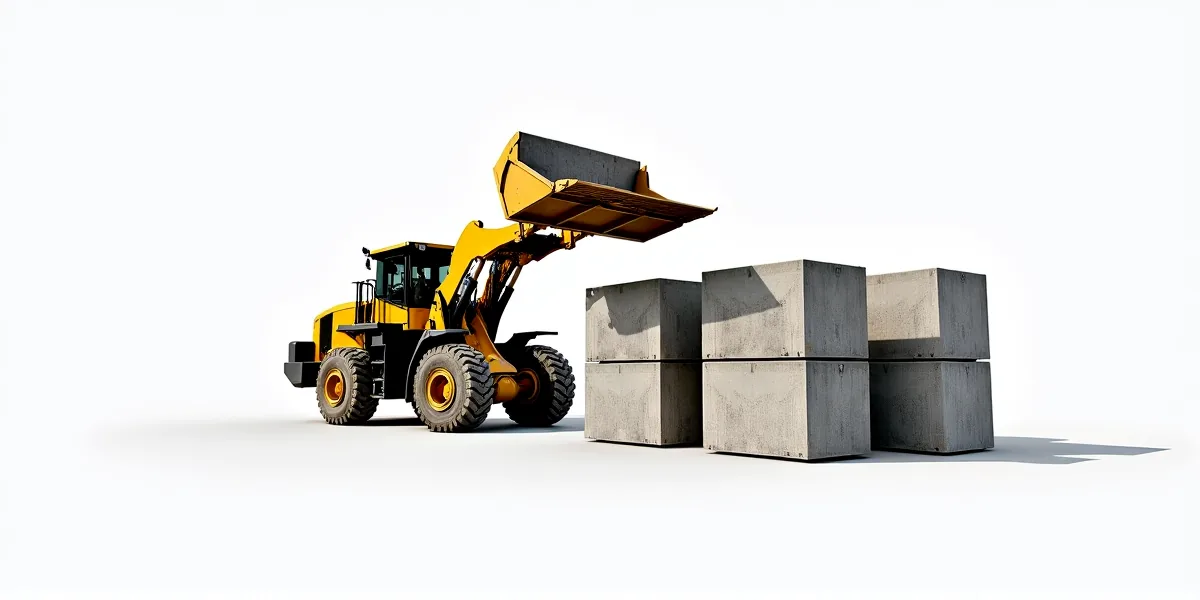
Understanding Tipping Load on Block Handlers: Safety and Stability
Block handlers are specialized machines, essentially wheel loaders fitted with heavy forged forks and reinforced counterweights, designed to lift dense stone and precast concrete blocks. Because these loads are significantly heavier and denser than standard bucket material, stability is a critical concern. The "tipping load" is the specific weight threshold where the rear tires lift off the ground, initiating a forward rollover. For any operator or buyer, understanding this metric is not just about passing a safety inspection; it is about preventing catastrophic failure in a quarry or precast yard. This guide breaks down what tipping load actually means in practice, how it differs from rated capacity, and how to manage stability risks on the job.
Defining Tipping Load vs. Rated Capacity
A common misconception in the industry is confusing the tipping load with the rated capacity. They are fundamentally different metrics. The tipping load is a static, theoretical limit measured under controlled conditions. It represents the absolute maximum weight that would cause the machine to tip forward on firm, level ground. It is a safety limit, not an operating target.
Rated capacity, on the other hand, is the maximum load the manufacturer certifies for safe, daily operation. This figure accounts for dynamic forces, such as vibration, uneven ground, and the machine’s ability to stop or turn. In practice, the rated capacity is always significantly lower than the tipping load. For Block handlers, you should never use the tipping load as a reference for how much you can lift. If you operate near the tipping load, a single bump in the road or a slight shift in the block’s center of gravity can cause a rollover. Think of tipping load as the cliff edge; rated capacity is the safe working area well before that edge.
Key Factors That Influence Stability
Several variables dictate how much weight a Block handler can actually carry safely. The most significant factor is the position of the load. As you lift a block higher, the center of gravity moves upward and forward, which drastically reduces the tipping load. A block that is safe to lift at ground level may be unsafe to lift ten feet in the air.
Machine configuration also plays a major role. Most Block handlers are articulated wheel loaders. When the machine is straight, it has the highest stability. However, when the machine articulates, particularly during a 40-degree turn, the center of gravity shifts, and the effective tipping load drops. This is why manufacturers provide two values: a straight-machine tipping load and a full-turn tipping load. The full-turn value is the governing limit for real-world maneuvering. Additionally, the counterweight assembly is critical. Unlike standard loaders, block handlers use heavier, reinforced counterweights to balance the massive forward loads of stone blocks. Any reduction in this counterweight, or damage to its mounting points, compromises the machine’s stability margin.
Static Testing vs. Real-World Dynamics
Tipping load figures are derived from ISO/SAE static tests performed on hard, flat pavement with the boom at a specific height and the load at a defined center point. These conditions are idealized and do not reflect the harsh reality of a quarry or precast plant. In the field, you deal with uneven terrain, loose gravel, and shock loading. When a Block is lowered onto a truck, the sudden impact creates dynamic forces that can exceed the static tipping limit even if the total weight is within the rated capacity.
Furthermore, off-center loading is a major hazard. If a block is not seated perfectly on the fork carriage, the load center shifts. This creates an uneven moment arm, reducing stability on one side of the machine. Operators must be trained to ensure blocks are centered and that the fork carriage is fully engaged. Relying solely on the static tipping load number without accounting for these dynamic and positional variables is a recipe for disaster.
Practical Advice for Safe Operation
To ensure safety and longevity for your block handler, adhere to strict operational protocols. First, always consult the specific load chart for your machine model and attachment configuration. Never exceed the rated capacity, even if the machine appears stable. Second, be mindful of lift height. If you need to lift a heavy block high, reduce the load weight to compensate for the reduced stability at height. Third, maintain the machine’s integrity. Loose counterweight bolts, worn pins, or damaged fork tines can alter the machine’s weight distribution and structural integrity. Regular maintenance, including checking the counterweight mount and inspecting forks for cracks, is essential to ensure the stability data remains valid.
Finally, train your operators to avoid shock loading. Lowering blocks gently and avoiding sudden stops while carrying heavy loads reduces the dynamic stresses on the frame and hydraulics. By respecting the difference between tipping load and rated capacity, and by operating with awareness of dynamic factors, you can maximize both productivity and safety in block handling operations.
Conclusion
Tipping load is a critical safety parameter for block handlers, representing the absolute limit of static stability. However, it is not a working limit. Operators and buyers must distinguish this theoretical value from the rated capacity, which is the safe operational threshold. By understanding how lift height, articulation, and ground conditions affect stability, and by maintaining the machine’s counterweight and structural components, you can prevent rollovers and ensure safe, efficient block handling. Always prioritize the manufacturer’s rated capacity and load charts over any static tipping figures when planning daily operations.