Introduction
If you are running a quarry, a precast yard, or a heavy civil construction site, you already know that moving stone blocks is a logistical headache. The traditional go-to has always been the counterbalance forklift. It’s cheap, it’s everywhere, and most operators know how to drive one. But when you start dealing with raw granite, massive marble slabs, or irregular natural stone, the forklift often becomes a liability rather than an asset. Enter the hydraulic block handler. Mounted on a wheel loader or excavator, these specialized attachments are designed specifically for the brutal reality of stone handling. But is it actually better? The short answer is: for heavy, rough, or high-value stone, yes, it is significantly better. For small, uniform precast blocks on a flat paved lot, a forklift might still suffice. In this guide, we will break down the practical differences, the safety implications, and the economic factors to help you decide which machine fits your operation.
The Fundamental Difference: Forks vs. Claws
To understand why one beats the other, you have to look at how they grip the load. A standard forklift relies on forks sliding underneath the object. This creates an immediate physical limitation: you need clearance. In a quarry, stone Blocks usually sit directly on the bedrock or loose aggregate. There is no gap for forks to enter. Operators often have to waste hours setting up wooden cribbing or using other heavy equipment just to lift a block enough to slide forks under it. This slows down production and increases the risk of the block tipping during the initial lift.
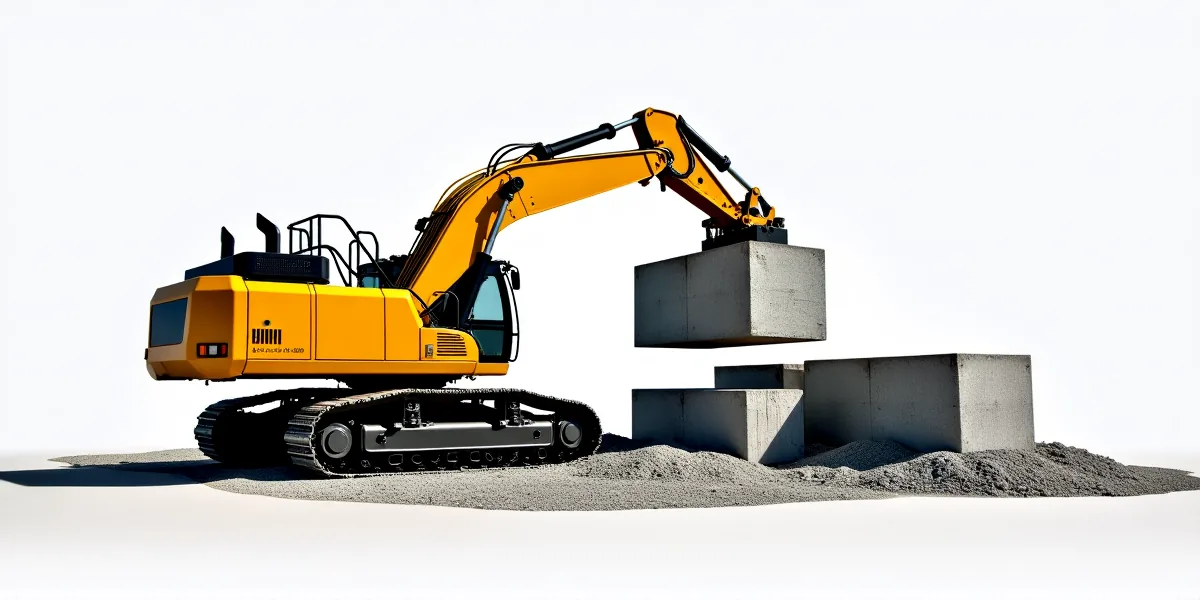
A Block handler, by contrast, uses hydraulic jaws to clamp the sides of the block. It does not need access underneath the stone. The jaws close around the material, distributing pressure evenly across high-friction rubber pads. This allows the operator to lift a block straight from the cutting bench or a stockpile without any preparatory groundwork. You can also rotate the block 360 degrees while it is in the air, which is critical for precise stacking and loading onto trucks. For a forklift, rotation is limited to the tilt of the mast, making precise positioning difficult without putting the machine at risk.
Stability and the Load Center Problem
Stone is dense. Very dense. This creates a physics problem for forklifts known as the load center issue. A forklift’s rated capacity is calculated based on a standard load center, usually 24 inches (600mm) from the heel of the fork. When you lift a massive stone Block, the weight often sits further forward than this standard distance. As the block gets heavier and longer, the effective capacity of the forklift drops sharply. If you try to lift a load that is technically under the nameplate rating but has a long load center, you create a high rollover risk, especially if you are on a slope or uneven ground.
Block handlers are engineered to manage this differently. Most are mounted on heavy-duty wheel loaders with four-wheel drive, high ground clearance, and integrated counterweights. The clamping mechanism changes the geometry of the lift. Because the jaws grip the sides, the center of gravity is managed differently, and the machine’s chassis is reinforced to handle the torque of carrying massive, off-center loads. On rough terrain, a forklift’s two-wheel drive and low clearance often lead to lost traction or getting stuck in mud and loose rock. A loader-mounted handler, with its deep-tread tires and 4WD, maintains traction and stability where a forklift would struggle or fail.
Protecting High-Value Material
In many operations, the stone is the product. If you are moving raw dimension stone or finished marble slabs, a chip or a crack is not just a nuisance; it is lost revenue. Forklifts are inherently rough on delicate loads. The forks are steel. If a Block shifts or slips, the result is often a sharp impact that cracks the stone. Even with careful driving, the vibration of a forklift moving over uneven yard surfaces can cause internal stress fractures in brittle materials like marble.
Block handlers offer a gentler, more controlled grip. The rubber pads on the jaws act as a buffer, absorbing shock and increasing friction to prevent sliding. The hydraulic system allows for precise, slow movements. An operator can lower a block millimeter by millimeter into position, ensuring it lands flat and secure without bouncing. This level of control protects the integrity of the stone, reducing waste and the need for costly repairs or discarding damaged inventory. For high-value stone, the cost of the handler is quickly offset by the reduction in damaged product.
When a Forklift Is Still the Right Choice
Let’s be clear: you do not always need a block handler. If your operation is strictly limited to a flat, paved factory yard, and you are handling small, uniform precast concrete blocks or lightweight paving stones, a standard forklift is likely sufficient. It is cheaper to buy, easier to maintain, and most drivers already know how to operate it.
Furthermore, if your blocks are very narrow, a forklift with narrow forks might be more versatile than a handler with a minimum clamping width. However, the moment you move into raw quarry stone, irregular shapes, or heavy natural granite, the forklift’s limitations become dangerous. Do not try to use a forklift for loads that exceed its safe load center or require lifting from uneven ground. The risk of rollover or load drop is too high.
Practical Selection Advice
If you decide to move to a block handler, do not just buy the biggest one you can afford. Selection requires specific measurements. First, measure the width and depth of your blocks. The handler’s clamping range must cover your block width, but also ensure the jaw depth matches the block depth. If the jaws are too shallow, they will not make full contact, leading to slips.
Second, check the lifting capacity curve. As the jaws open wider, the safe working load typically decreases. Ensure the handler can lift your heaviest block at the maximum jaw opening you will need. Third, verify the mounting compatibility with your existing loader or excavator. Finally, consider the terrain. If you have slopes, ensure the handler has a long wheelbase and adequate counterweight. Buying a handler that is too small for your stone is a safety hazard; buying one that is too large is a waste of capital. Match the tool to the stone.
Conclusion
For the modern stone operation, the block handler is not just a luxury; it is a productivity and safety tool. It solves the fundamental access problems that plague forklift operations, offers superior stability on rough terrain, and protects high-value material from damage. While the upfront cost is higher than a standard forklift, the reduction in labor time for cribbing, the decrease in damaged stone, and the ability to work in environments where forklifts fail, makes the handler a superior investment for serious quarry and stone handling operations. Evaluate your specific block sizes and terrain, and you will likely find that the forklift has outgrown its role in your workflow.