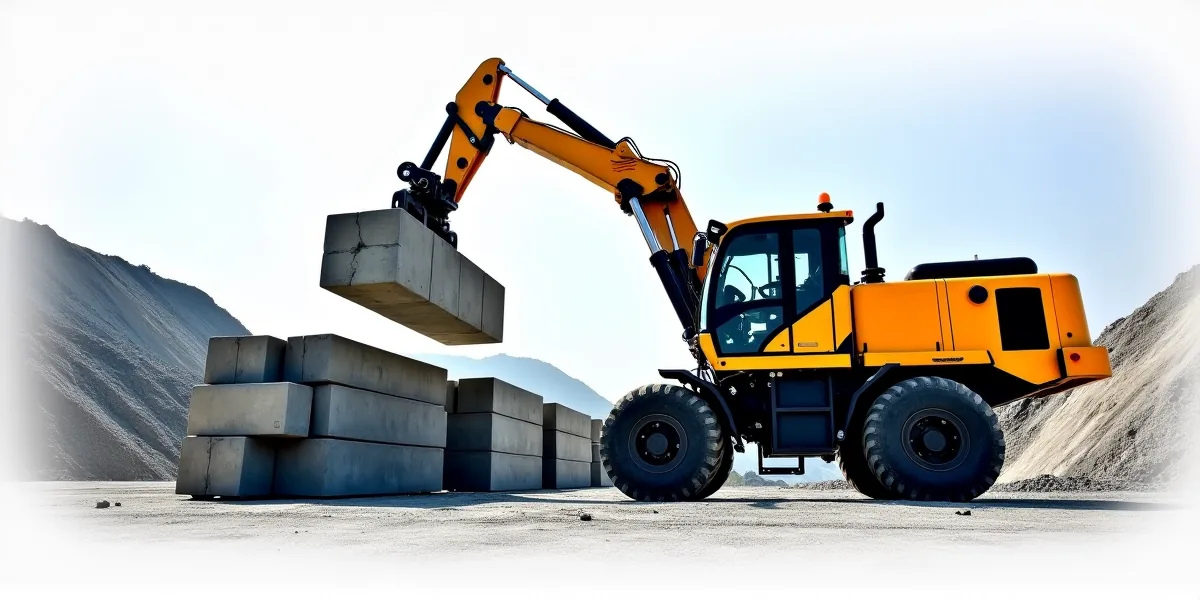
Block Handler vs. Reach Stacker: Which Machine Fits Your Yard?
When you are looking to move heavy loads in an outdoor yard, two machines often come up in the conversation: the Block handler and the reach stacker. At a glance, they are both heavy-duty lifters with big engines and substantial counterweights. However, choosing the wrong one can lead to wasted capital, safety hazards, and operational bottlenecks. They are engineered for completely different environments and cargo types. Understanding the distinction is critical before you sign a purchase order or a rental agreement.
Core Design Philosophy: Traction vs. Reach
The fundamental difference lies in what each machine is trying to solve. A Block handler is essentially a specialized wheel loader. It is built on an articulated chassis with high ground clearance, heavy-duty off-road tires, and a fixed vertical mast. Its strength is stability and traction. It is designed to carry dense, monolithic loads close to the machine’s body over rough, uneven terrain like gravel, rock, and mud. It does not have a telescopic boom; it drives to the load, lifts it, and drives away.
In contrast, a reach stacker is a precision port machine. Its defining feature is the long telescopic boom. This allows the machine to reach forward over the first row of cargo to pick up or place items in deeper rows, or to stack cargo several units high. It is engineered for flat, paved surfaces. The reach stacker prioritizes horizontal reach and vertical stacking precision over the ability to traverse rocky ground. It is not built to handle the shock loads of irregular stone, nor is it designed to operate on slopes or loose dirt.
What They Actually Lift: Stone vs. Containers
Material compatibility is the easiest way to decide between these two. Block handlers are built for dense, solid, single-piece loads. This includes raw granite or marble quarry blocks, precast concrete wall panels, bridge segments, and heavy palletized masonry. The forks on a block handler are thick, forged steel designed to absorb the impact of dropping a heavy stone block. The load is irregular and heavy, often sitting forward of the axle.
Reach stackers, on the other hand, are designed primarily for ISO shipping containers. The standard attachment is a spreader that locks onto container corners using twistlocks. While some reach stackers can handle steel coils or heavy industrial cargo with specialized attachments, they are not suitable for rough stone. The hydraulic components and spreader mechanisms are delicate compared to a Block handler’s forks. Attempting to lift irregular, rough-edged stone with a reach stacker’s spreader or standard forks will likely damage the equipment and create a safety risk due to the uneven load distribution.
Capacity and Performance in Real Conditions
Both machines have significant lifting capacities, but the way that capacity is applied differs. A mid-size Block handler, rated at 20 tonnes, is designed to lift that weight at a low height with a standard load center (typically 500mm from the fork face). As you lift the block higher, the safe working load drops significantly due to the increased tipping moment. A 20-tonne handler might only safely lift 14–16 tonnes when fully raised. This is normal and expected. The machine is stable because the load remains close to the chassis.
Reach stackers face a different challenge. A standard container reach stacker might be rated for 45 tonnes when lifting a container in the first row close to the machine. However, as the boom extends to reach the second or third row, the leverage changes, and the safe capacity drops sharply, often to 30 tonnes or less. The reach stacker’s advantage is not raw low-height strength, but the ability to access deep storage without moving the entire machine. In a block handler’s world, you move the machine to the block. In a reach stacker’s world, the machine stays put and reaches out.
Cost Implications and Maintenance
Price is a major factor, and the gap is significant. A new mid-size block handler typically costs between $120,000 and $350,000. Used models can be found for $70,000 to $200,000. Maintenance is comparable to other heavy construction equipment; parts are widely available, and the mechanical systems are robust. Daily rental rates for mid-size models usually range from $350 to $700.
Reach stackers are significantly more expensive. A new standard 45-tonne container reach stacker can cost between $400,000 and $900,000. Because of the complex hydraulic and electrical systems in the boom, maintenance is more specialized and costly. Parts are often supplied exclusively by the OEM. Daily rentals are rare; most operators sign long-term monthly leases, which can run $15,000 to $20,000 per month. If your job is moving stone blocks, the reach stacker is not just the wrong tool; it is a financial liability due to the high entry cost and specialized maintenance requirements.
How to Choose the Right Machine for Your Operation
The decision comes down to your site conditions and your cargo. Choose a block handler if you are in a quarry, precast concrete plant, or stone yard. Your ground is likely unpaved, rocky, or muddy. Your loads are heavy, dense, and irregular. You need to move these items across the yard, load flatbed trucks, and stack them in rows. A block handler provides the stability and traction required for this work. A rough-terrain forklift might work for lighter loads, but for anything over 10 tonnes on uneven ground, a block handler is the safer, more efficient choice.
Choose a reach stacker if you operate a port, intermodal rail terminal, or container yard. Your surface is flat and paved. Your primary cargo is standardized ISO containers. You need to stack containers multiple rows deep and several units high. The reach stacker’s ability to reach into deep storage saves yard space and time, eliminating the need to constantly move machines to access different rows. It is the industry standard for container logistics.
Do not try to use a reach stacker for quarry work, and do not expect a block handler to stack containers in a port yard. Matching the machine to the specific physics of your job site is the most practical way to ensure safety, efficiency, and cost-effectiveness.