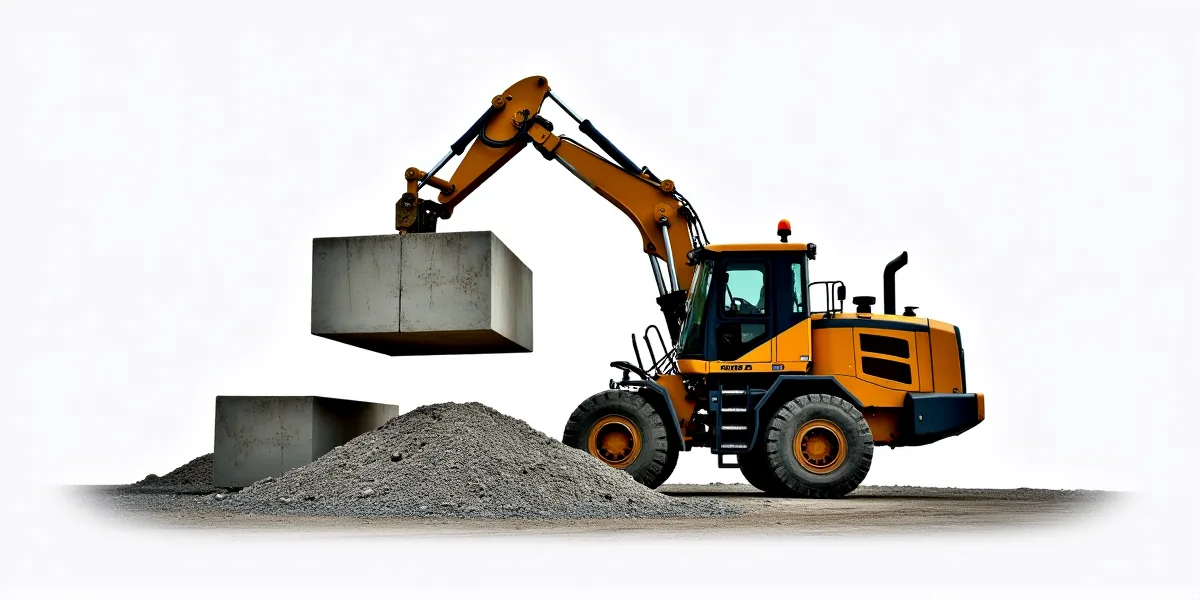
Introduction: More Than Just a Big Forklift
If you have ever visited a granite or marble quarry, you have likely seen a machine that looks like a giant wheel loader but moves with the precision of a crane. This is the block handler, also known as a stone block loader or stone forklift. It is a specialized piece of heavy equipment designed for one specific purpose: picking up, transporting, stacking, and loading massive, dense solid stone blocks.
While standard wheel loaders are versatile workhorses for moving soil, sand, and aggregate, they are not built to handle the sheer weight and fragility of multi-ton stone blocks. Attempting to use a standard loader for this task often results in cracked stone, damaged machine hydraulics, or worse, catastrophic tipping accidents. Understanding what a block handler is and why it is distinct from other Machinery is essential for anyone involved in stone quarrying or processing.
Primary Applications in Quarries and Stone Yards
The block handler is the backbone of natural stone extraction. Its primary home is the quarry floor, where it handles raw blocks of granite, marble, limestone, travertine, and basalt. In a typical granite operation, diamond wire saws cut large rectangular blocks from the rock face. Once a block is freed, the block handler picks it up, moves it across the rough, uneven terrain to a temporary stockpile, and eventually loads it onto flatbed trucks for transport to processing factories.
These machines are equally critical in finished stone yards and fabrication plants. Here, they stack semi-processed blocks in organized rows, feed blocks into sawing lines, and load thick slabs onto delivery vehicles. The workflow is demanding; the machine must operate continuously in environments filled with loose rock, deep ruts, and significant slopes. Because marble is softer and more brittle than granite, the smooth hydraulic control of a block handler is vital to prevent cracking and surface damage during handling. Some larger units also operate at ports to manage bulk stone shipments and containers.
Key Differences Between Block Handlers and Standard Forklifts
A common misconception is that a block handler is just a very large forklift. In reality, they are mechanically and structurally different machines built for different environments. A standard rough-terrain forklift uses a vertical mast to lift forks straight upward. It has a compact chassis and low ground clearance, designed for flat, paved, or compacted yards.
A block handler, by contrast, is built on an articulated wheel loader base. Instead of a vertical mast, it uses a front boom linkage with long, heavy-duty pallet forks attached to the boom. This design offers several critical advantages for quarry work:
Stability and Frame Strength: Block handlers feature a much longer wheelbase, oversized heavy counterweights, and reinforced box frames. They are engineered to support extreme tipping loads that would instantly tip over a standard forklift. The heavy-duty axles are designed to withstand the shock of dropping and lifting massive stone weights repeatedly.
Ground Clearance and Tires: To navigate the chaotic terrain of a quarry, block handlers have significantly higher ground clearance and larger, reinforced rock tires. They can roll over loose rock, ruts, and rubble without damaging the undercarriage, a feat impossible for standard forklifts which often get stuck or suffer chassis damage on such surfaces.
Lift Geometry and Steering: The boom arms on a block handler lift and tilt the entire fork carriage, keeping the load parallel through the lift cycle. This prevents the bending stress that can occur in standard forklift masts under extreme weight. Additionally, the articulated steering hinge between the front and rear chassis allows for tight turning radii on rough ground, whereas rigid-frame forklifts struggle to maneuver in tight quarry spaces.
Capacity: Block handlers routinely handle stone blocks weighing 18 tons, 26 tons, 32 tons, and even up to 50 tons. Standard rough-terrain forklifts rarely exceed 15 tons and are not built for the continuous heavy-lifting cycles required in a quarry.
Materials Handled and Limitations
Block handlers are designed for solid, monolithic rectangular blocks. The primary materials include granite, marble, limestone, travertine, basalt, and quartzite blocks cut from quarry beds. These materials are heavy, dense, and often have uneven, rough base surfaces that require careful engagement by the forks.
Beyond natural stone, these machines can move large concrete blocks, precast stone barriers, and heavy engineered stone blocks in manufacturing plants. However, it is important to note what a block handler is not for. It is not ideal for loose aggregates, gravel, soil, or thin, loose slabs. Using a block handler for loose material is inefficient and can lead to material spillage and unnecessary wear on the fork tips. The machine is optimized for single, heavy, solid loads.
Practical Advice for Buyers and Operators
When selecting a block handler, do not just look at the maximum lift capacity. Consider the specific dimensions of the blocks you are moving. The length and width of the forks must accommodate your largest standard block size with room to spare for safe engagement. Manufacturers like JINGONG and Volvo offer models engineered specifically for this niche, and their hydraulic systems are tuned for the smooth, controlled movements that protect stone integrity.
Operators must be trained in the unique physics of stone handling. Unlike soil, stone does not shift or compress. A slight miscalculation in fork placement can lead to a block sliding off the forks or cracking under uneven pressure. Always ensure the block is fully seated on the forks before lifting. Furthermore, maintain the hydraulic systems rigorously. Leaks or sluggish response times can cause the load to drop or shift, resulting in expensive stone breakage. Regular inspection of the boom pins, hydraulic hoses, and fork teeth is non-negotiable for safety and efficiency.
Conclusion
The block handler is a specialized tool for a specialized job. It bridges the gap between the mobility of a wheel loader and the precision of a forklift, providing the stability and power needed to move massive stone blocks in harsh quarry environments. For stone quarries and processing plants, it is not just a convenience; it is a necessity for safe, efficient, and damage-free material handling. Understanding its unique capabilities and limitations ensures that operators can maximize productivity while protecting both the machine and the valuable stone it carries.